
Yahoo’s big AI play is, in many ways, actually a return to the company’s roots. Three decades ago, Yahoo was known as “Jerry’s guide to the world wide web,” and was designed as a sort of all-encompassing portal to help people find good stuff on an increasingly large, hard-to-parse internet. In the early aughts, the rise of web search more or less obviated that whole idea. But now, Yahoo thinks, we’ve come back around.
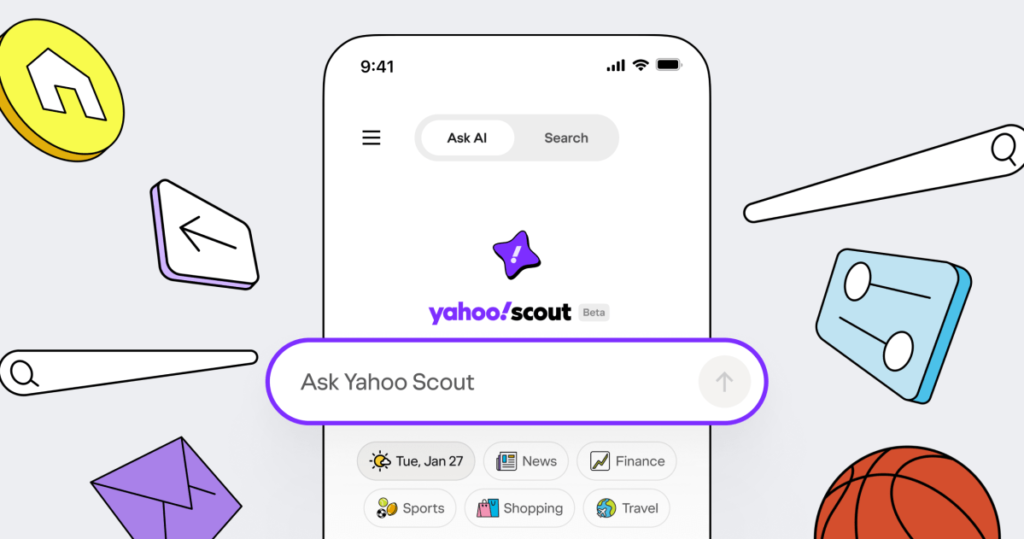
With a new product called Scout, Yahoo is trying to return to being that kind of guide to the web — only this time, with a whole bunch of AI in the mix. Scout, in its early form, is a search portal that will immediately be familiar if you’ve ever used Perplexity or clicked over to Google’s AI Mode. It shows a text box and some suggested queries. You type a question; it delivers an answer. Right now Scout is a tab in Yahoo’s search engine (which, CEO Jim Lanzone likes to remind me every time we talk, is somehow still the third-most-popular search engine in the US), a standalone web app, and a central feature in the new Yahoo Search mobile app. Yahoo calls it an “answer engine,” but it’s AI web search. You get it. And so far, it’s the most search-y of any similar product I’ve tried. I like it a lot.
Scout has two jobs, really. The first is just to be a guide, to find stuff on the web. “It’s moved from ‘how do I find things on the internet’ to weeding through clickbait and now AI slop,” says Eric Feng, who runs Yahoo’s research group and has been leading the Scout project. But Scout’s job is also to bring AI summaries and smarts to all of Yahoo’s other products, and to help Yahoo users pull all that disparate data into one place.
In a funny twist, Yahoo may be perfectly positioned to do this well. Because Yahoo runs huge content verticals like Sports and Finance, with a big newsroom of its own and partnerships with many other publishers, it has a huge amount of high-quality reference material for Scout. It also has Yahoo Weather and Yahoo Mail and Yahoo Horoscopes and Yahoo Shopping and Yahoo So Many Other Things Besides. Yahoo is a full-fledged content machine, and it can just point an LLM at all that content. “We’re the only ones who can take our user data, our usage data, our content, our relationships and information, and combine that with everything we know about search into an AI answer engine,” Lanzone says.

Google would probably take issue with that statement. It has many of Yahoo’s same advantages, and a bunch of other ones, and a lot more users. But Yahoo has one key win over Google: It doesn’t have a massive, indomitable search-ads business to protect. Because of the sheer scale of both its user base and its revenue, Google has to slow-play its way into making AI Mode the face of Google Search, even though that’s obviously the plan. Yahoo has no such qualms: Lanzone says Scout won’t replace standard Yahoo Search from day one, but makes it pretty clear that that’s the plan before long.
There is still a business plan here, though. Scout is launching with affiliate links for shopping results and an ad unit at the bottom of some searches. All the AI search products seem to be deciding that ads are the way to monetize AI, and Yahoo is set up to get there quickly. The goal, Lanzone says, is to use ads to keep Scout free for everyone. “Maybe one day we’ll also have a paid tier,” he adds, “but free search is extremely important.”
One thing Yahoo isn’t doing? Building its own foundation model. For one thing, Lanzone says, doing that is very expensive. “We think we can best serve our users not so much with the model,” he says, “but with the grounding data and the personalization data that we can add on top of other people’s models.” Scout is based on Anthropic’s Claude model, and what Feng describes as “Yahoo content, Yahoo data, Yahoo personality.” Much of the web-search data comes from a partnership with Microsoft and Bing, as it has for many years.

Everybody doing AI search swears they care deeply about the future of the open web, but in my testing so far, Scout is the most web-forward AI search product yet. When I asked Scout, “What’s the latest on this winter storm?” it responded with a one-paragraph summary that included three links prominently highlighted in blue. After that, I got three sections of more details about what’s happening in my Virginia town, the forecast to come, and then a “Latest News” section with links to Yahoo stories, Yahoo partner stories, and other links around the web. In total, the page had nine links, plus a way to see all the page’s sources at once.
When I did the same search on ChatGPT, Perplexity, and Google AI Mode, I got similar summaries, structured in similar ways. ChatGPT was the only one to link more prominently: It stuck a carousel of news links right at the top of the page. Other than that, all three platforms seem to hide links behind icons or light-colored buttons — only Scout seems to actually want you to click the links. Making sure people actually do click them will be crucial to the rest of Yahoo’s business, and to keeping its newsroom and publisher partners on board with Scout’s existence.
In my early tests of Scout, it feels much more like a search engine than an AI companion. Its tone is very straightforward, and it doesn’t present like a friend to talk to. It’s just a way to find information on the internet, organized conversationally rather than as a bunch of links. That doesn’t sound particularly novel, but in a sea of AI tools that would love to pretend the internet doesn’t exist at all, it’s a refreshingly useful take on the genre. I don’t think I’ve used Yahoo Search on purpose in a decade, but when I wanted to know when the Winter Olympics started, Scout gave me a better answer than any other search engine I tested. That’s not enough to take on Google, but it’s a decent start.