
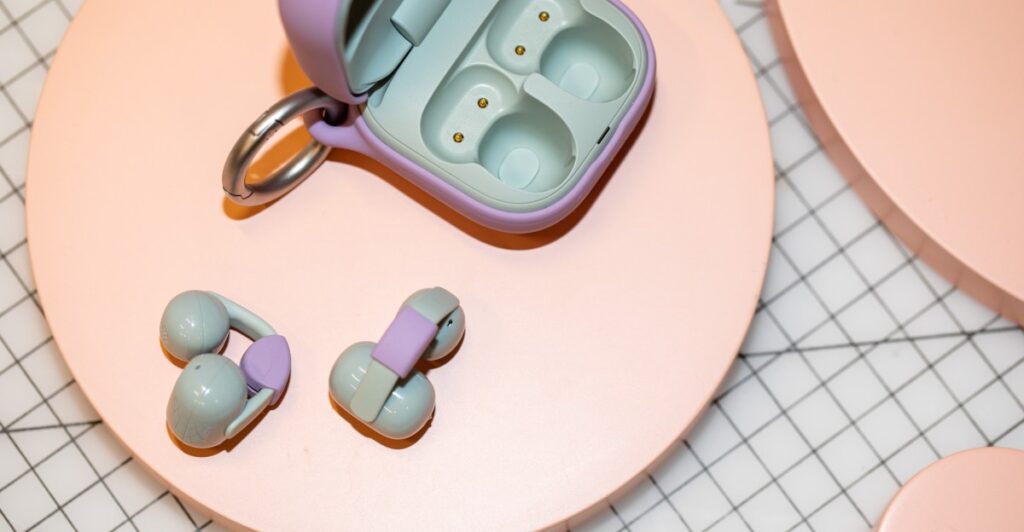
The Sony LinkBuds Clip are the company’s first clip earbuds. They follow the innovative donut-hole LinkBuds and LinkBuds Open and, like their predecessors, allow you to listen to music or podcasts, make phone calls, or be active outdoors while still maintaining awareness of your surroundings. The clip design has become more popular over the past couple of years, and while the LinkBuds Clip have a solid design and good sound, there’s nothing significant that sets them apart from competitors, especially at their $229.99 price.
Like other open earbuds, the LinkBuds Clip wrap around your ear helix like an ear cuff. The small spherical speaker enclosure is positioned just outside your ear canal and is connected by a flexible band to a larger capsule-shaped housing that rests on the outside. I like the look of the Clip buds, with their slightly glossy enclosures and selection of subdued color tones, including lavender, green, greige (a grayish beige), and black. Some might prefer a bolder, flashier look, but I like the green sample Sony provided. You can also mix and match five different case covers — black, green, blue, coral, and lavender — to customize them.


$230
The Good
- Excellent call quality
- Comfortable fit
- Long battery life
- Good sound for open earbuds
The Bad
- More expensive than competitors
- Missing some expected features
The Clip are intended to sit midway up your ear, but since everyone’s ears are different, there could be some adjustment to find the most comfortable spot for you (for me, it’s a little lower on my ear). Once you find the sweet spot, putting the earbuds on is quick and easy, although I found the fit a bit loose. The band isn’t as flexible as the one on the Shokz OpenDots One, which fit more securely around my ear. Instead, Sony includes silicone “cushions” that fit around the band. (Color-matching cushions come with the additional top case covers.) They gave me the secure fit I was looking for, and I was able to wear them for nearly an entire workday without discomfort. I even forgot I was wearing them at times, since they let in ambient sound. Those with larger ears might feel more of a pinch from them, even without the cushions attached.

The highs and lows of the Clip’s sound performance
While I preferred the fit of the LinkBuds Clip with the cushions, using them affected the sound balance. The cushions caused the speakers to sit just a bit farther away from my ear canal, which resulted in less bass performance. And the Clip — and really every pair of open earbuds — are a bit light on thumping bass. There are three primary listening modes: standard, voice boost, and sound leakage reduction.
Standard mode sounds the most natural, with a clear midrange that doesn’t overpower the higher frequencies. Voice boost added a bit too much vocal presence that became oppressive over longer music listening sessions, but added good clarity for podcasts and news programs. The sound leakage reduction mode cuts out much of the high-end response, limiting potential disturbances to those around you, but it also makes the music sound muffled and dull. And there wasn’t a significant amount of leakage anyway, even in standard and voice boost modes.

There are some presets in Sony’s Sound Connect app, as well as a 10-band equalizer, if you want to boost or cut a specific frequency range. For some of my more rocking tracks — Soundgarden’s “Spoonman,” for instance — I pumped up the bass and low mids a bit. There’s also Sony’s DSEE, which improves the sound of compressed audio a little bit.
The LinkBuds Clip really shine when on calls. They have a new AI noise-reduction chip and bone-conduction sensor that allow them to focus on the wearer’s voice and isolate it from the noise around them. During multiple calls while walking down the busier streets in my Los Angeles neighborhood, my friends could easily hear me, while the traffic around me was suppressed. There were occasional moments where they commented about hearing a gust of wind or the sirens of a nearby police car, but they were fleeting. It was during those moments, though, that I had some trouble hearing them because of the Clip’s open design.
I was a bit surprised at some of what was missing with the LinkBuds Clip, especially for $230. While they have good battery life at nine hours per charge (and another 28 hours with the case), the case doesn’t have wireless charging. The earbuds support the standard SBC and AAC codecs, but Sony’s own high-res LDAC is missing. They also don’t have audio sharing, which is available on the WF-1000XM5 and can now be found for only $25 more than the Clip.
The touch controls can be finicky. You use multiple taps for different controls — two taps on the right side to pause and play, three taps for the next song, and four taps to raise the volume (or lower the volume on the left earbuds). But the spot to tap on the band has a small margin of error, so if my finger was off target at all, the taps wouldn’t register. It was even harder while jogging. I’d need to slow down to a fast walk to get better control.


You can set up scene-based listening in the Sound Connect app, which allows you to customize the earbuds’ functionality based on your activity or location. So you can have a specific playlist start when you start running, or when you arrive home, the app can switch to your favorite music streaming service. You can also have the app read out notifications in your ear. It’s an interesting feature if you have certain routines and invest in the time to set it up.
It makes sense that Sony came out with the Clip, especially since it helped popularize the open earbuds trend with the original LinkBuds. And the Clip are good earbuds that look cool, sound pretty good, and are comfortable. But for $230, there’s nothing that sets them apart from other recent open earbuds like the Shokz OpenDots One and EarFun Clip, both of which are cheaper. Once they come down in price or go on sale, they’ll be much more of an enticing purchase. But until then, unless you’re in love with the LinkBuds Clip look, it’s better to wait.
Photography by Amelia Holowaty Krales / The Verge