
This is Lowpass by Janko Roettgers, a newsletter on the ever-evolving intersection of tech and entertainment, syndicated just for The Verge subscribers once a week.
Get ready for a lot more video content on Spotify. Sometime later this month, the service will start incorporating music videos into its app, and give US-based subscribers the ability to easily switch back and forth between audio and video versions of many popular songs.
And Spotify isn’t stopping there. “We’re not just building features; we’re creating a best-in-class video experience to rival the biggest players, like YouTube or TikTok,” the company declared in a recent job listing. Spotify is evolving “from an audio-first platform to also become a world-class video service,” that job listing states.
Spotify’s expansion into music videos comes after the company struck licensing agreements with the major labels and the National Music Publishers’ Association this fall that specifically included provisions for audiovisual rights.
“These deals secure broader video rights that we’ve long needed,” explained Spotify’s chief business officer, Alex Norström, on the company’s most recent earnings call last month. “This was a critical strategic objective for us because it unlocks our ability to innovate and launch more products and features.”
Spotify has also been busy adding other forms of video content, with Norström revealing during the same earnings call that it now has close to half a million video podcasts and shows on its platform. More than 390 million users have streamed video podcasts on Spotify, and time spent watching videos has more than doubled year over year, according to Norström.
MIDiA Research managing director Mark Mulligan believes Spotify’s embrace of video is a sign of the times for the online music business, which is starting to hit a ceiling in Western markets. “Music streaming is entering an optimization phase,” Mulligan says. “The last 10 years were about growth; the next 10 will be defined by consolidation.”
With most consumers who are willing to pay for music already subscribed to a streaming service, Spotify’s focus has to shift to growing its share of audience time, to retaining paying subscribers, and to better monetizing those on its ad-supported tier. That means the service isn’t just competing with Apple Music and other music streaming services anymore, but with anything else occupying our eyes and ears, whether that is TikTok, Netflix, or even video games.
Spotify is also at a disadvantage because music tends to be a background medium for many people, argues Mulligan. “Adding video helps Spotify increase attention,” he says. “Of all entertainment formats, music is the one consumers are least likely to be paying attention to — just under a third are focused on the music they are listening to when streaming. Adding video commands more of the senses and therefore attention.”
There’s one platform that has already nailed this combination of music and video: YouTube. The Google-owned video service has long been the most popular destination for free music, with MIDiA finding in a consumer survey this summer that 67 percent of consumers watch music videos on YouTube monthly compared to 45 percent that stream music for free and 37 percent that have a music subscription.
Plus, YouTube has its own music subscription service in YouTube Music, which is benefitting from its tight integration with the site’s massive video catalog. “It is a visual medium in an entertainment world defined by video,” Mulligan says. “YouTube [Music] is also the only other global player than Spotify that is growing at pace. So, even though it is not the biggest competitor to Spotify, it is probably the most serious challenger at present.”
In light of all this, Spotify is willing to strike some unusual alliances to grow its own video audience. The company announced a deal with Netflix to bring The Bill Simmons Podcast and other Spotify podcasts to the video service in October. It’s not the only partnership of this kind: Spotify has also teamed up with Samsung, which is syndicating a free, linear streaming channel preprogrammed with episodes from Spotify podcasts like The Dave Chang Show and The Rewatchables.
In addition to extra revenue, Spotify also expects those deals to generate additional interest in Spotify podcasts, which could then lead to more eyeballs flocking to Spotify itself.
The big question is now: How far is Spotify willing to go in its embrace of video? Would the company ever open up the floodgates and allow anyone to upload their own clips like YouTube and TikTok do?
The company declined to comment when asked about its plans for video going forward, but I wouldn’t hold my breath for Spotify going full TikTok. Allowing you, me, and my conspiracy theory-loving uncle on Facebook to upload our unfiltered rants to the service would come with massive copyright and content moderation challenges.
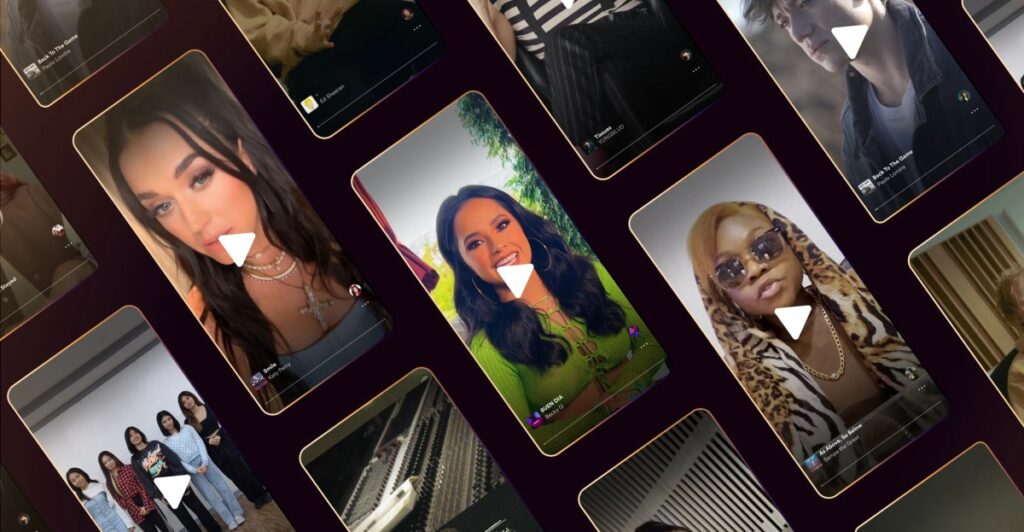
However, the lines between amateurs and professional creators continue to blur. Spotify already allows artists to upload Reels-like 30-second vertical video clips. The company also added such clips from podcasters and audiobook authors to its 2025 Spotify Wrapped.
The logical next step would be to onboard select music influencers, believes Thematic COO Audrey Marshall. “Music curators have become some of the most popular creators on [TikTok], with their frequent song, artist, and playlist recommendations driving new music discovery across all genres and niches of music,” Marshall wrote in a recent blog post.
That’s despite the fact that TikTok itself isn’t the best driver of such recommendations. “Right now, in order to get a TikTok music curator’s latest artist recommendations, you need to open TikTok, hopefully be recommended their content in your feed, watch their video, leave TikTok and open Spotify to look up the artist, etc. etc.,” Marshall wrote. “Wouldn’t it be that much more effective to see this video directly within Spotify and then simply click to play the artist’s music immediately?”
Whether Spotify follows Marshall’s recommendation or not, it’s increasingly certain that video will be a key part of Spotify’s future — on phones, TVs, and everything in between.