
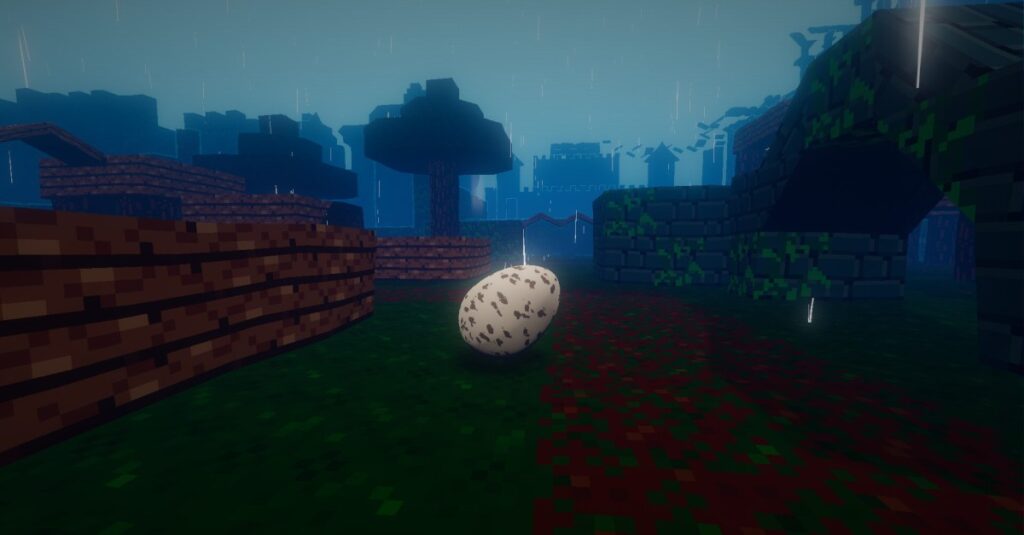
The funny shape of eggs is the curious lifeblood of Oeuf, the new physics platformer by prolific developer Increpare Games. In a gaming landscape saturated with complex systems dropped into simple games, that grapples with metaphor within straightforward narratives, and that is desperate to bring cinematic sensibilities into gaming, Oeuf only asks that you briefly consider how an egg might move as you roll, slide, and hop across its world.
That world is realized in crunchy, ’90s-era 3D that brings to mind Ultima and Might and Magic. Like this archaic-seeming style — that Oeuf was released within a month of Resident Evil Requiem is a fun graphical comparison — Oeuf is refreshingly simple. Blown from the nest atop a church steeple, you, a brown-speckled egg, must navigate church grounds, climb up trees, cross sloping roofs, and clamber over jutting bricks to get home.
Your nameless egg is unpredictable. Smooth but prone to being overzealous in its haste when on its side; less controllable but more balanced on its end. Much of the challenge in Oeuf comes from positioning yourself, through tiny movements on similarly tiny platforms, to build momentum for a jump and arresting that motion before you tumble to the ground on the other side. When you fall — and you will fall — the game greets you with an “oof.” Being an egg, however, this is rendered as a pleasing “oeuf!”
If this is all sounding too Getting Over It with Bennett Foddy, Oeuf is generous with checkpoints that remove much of the grinding irritation of similar games while maintaining the surmountable frustration that makes them satisfying. Those checkpoints create a comfortable rhythm.
There is a temptation in games built on repetition and accompanying frustration to keep mounting the difficulty until challenge turns to drudgery. In mixing up the length of sequences with a clever weaving of shorter sections between longer ones, Oeuf creates a rewarding sense of forward motion with a pulsing mix of punishing and more relaxed sequences. Players breaking through a tense run of incremental platforming are often greeted by several shorter areas based on different mechanics like completing impossible jumps through building up speed on slopes.
Mileage on that may vary, likely based on how you relate to Oeuf’s 3D world. I preferred navigating lateral crossings and challenging climbs; others may gravitate toward bouncing off obstacle courses and puzzles governed by player momentum. One of the most challenging sections I encountered came early, as I navigated my egg over a series of descending ramps, while I had little trouble with climbing a tree soon after. For others, it may well be the inverse.
Oeuf understands that players can only get so frustrated before they stop playing. In fact, its choreographed rhythm appears to encourage that. Checkpoints already delineate clear opportunities to start and stop, but a generous attitude to maintaining player progress means stepping back in response to a frustrating section is often the recipe for coming back soon after and blitzing a sequence on which you’d previously been stuck. The joy of overcoming is only increased as you race through the following sections — sometimes literally, particularly when tasked with navigating slopes. It’s a level of technical self-awareness that eludes so many similar games.
That said, Oeuf is at its best when it’s asking you to jump. Some of its momentum-based puzzles can be finicky, particularly when the way the egg moves and bounces renders some jump inputs unresponsive. This appears to be a side effect of how the egg lifts off the ground when bouncing on its end, rather than a programming error.

Image: Increpare Games
Not every section enjoys the same generous checkpoints. One particularly provoking area that sees you traverse a series of sloping surfaces left me stumped across multiple sessions. Not for a lack of solutions — the only option was to balance on the corners of blocks — but for how unforgiving it was. When I finally made it through, I was surprised not to find a checkpoint waiting in line with the rhythm that both preceded and followed the section. Instead, the eventual checkpoint came after a lengthy series of jumps. This was the only discordant moment I perceived in Oeuf’s otherwise comfortable rhythm.
You can, however, skip areas using the built-in map editor — in which you can also build your own courses — or you can edit frustrating sections into something more forgiving to avoid actual bottlenecks. You may even, in stepping away from a frustrating section, unwind on one of the custom maps already included. Intended or not, the function offers an interesting accessibility solution to break out of any loop in which you find yourself.
Not that those are going to be common for most players. Oeuf is, paradoxically, a chill game. You may grind your teeth in places, squeeze the controller too hard, but Oeuf is trying — not always successfully — to get you to decompress. In the mellow soundtrack, the natural tones and sound of the wind, Oeuf gives you every chance of entering a relaxed state of pure concentration. Whether you can or not likely depends on how you react to being perched precariously on the edge and desperately twitching the joystick to keep your bottom-heavy egg from tipping into the abyss.
Still, it’s hard to get too frustrated with Oeuf. With quick restarts, surmountable obstacles, and generous checkpoints, the relationship with failure it fosters is a comfortable one. A popular framework in video game reviews is to find meaning in a game outside the obvious. Games secretly represent moments in time, capture bygone feelings, or help you discover something about yourself. Oeuf really is just a game about being an egg and hopping up a series of platforms. It’s just fun — really, really fun.
Oeuf is available now on Steam.