
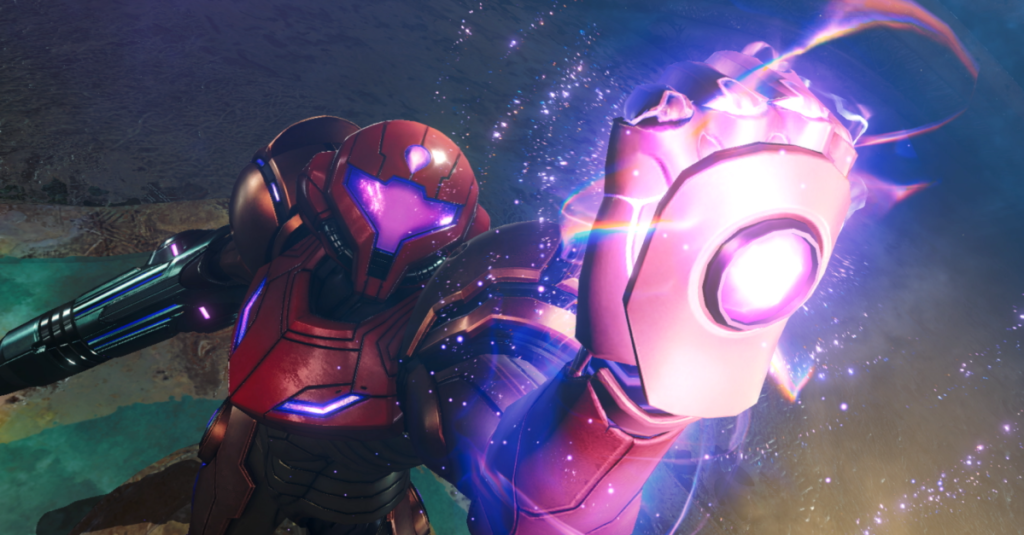
Metroid Prime 4: Beyond is finally out after a long and difficult development — and despite some bright spots, the game really shows its age.
Nintendo has a long and celebrated history of doing things its own way. During the original Switch era, going back to Super Mario Odyssey in 2017, Nintendo has focused on bringing open-world style exploration elements to many of its major releases. That strategy has worked very well, breathing new life into storied franchises like Donkey Kong, Mario Kart, and The Legend of Zelda. But it hasn’t quite added the same revolutionary touch to Metroid Prime 4.
In all of the other games that got the open-world-style treatment, those elements were additive to the experience. Exploring vast stretches of Hyrule in Breath of the Wild, for example, inevitably led to some kind of new discovery — a shrine to crack, a korok to uncover, or a treasure to find. We had never seen Hyrule rendered like that on a Nintendo console, and it was neat to traipse about it and take it all in.
In Beyond, though, that kind of exploration is more of a chore than a treat. In his review, Andrew Webster described the desert hub world Samus travels through as “a bare and boring place.” There are things to discover, but they’re no more than mile markers on a long stretch of desert.
The problem is that for the type of game Metroid is, free-roaming exploration doesn’t work, or at least not in this execution. In the early hours of Beyond, while zipping across the desert on the extremely cool-looking VI-O-LA bike, I encountered a wrecked structure belching smoke. After taking care of a few enemies, I looked around to see if there was any puzzle to solve or treasure to take, only to find nothing. There seemed to be something higher up that I could interact with, but I couldn’t reach it. So I left.
A Metroidvania gates progression behind power-ups. When you encounter a roadblock, that’s typically your signal to come back later. That works in a closed environment like the biomes of Viewros, the new planet Samus explores, but it kills momentum in an open world because there’s no guaranteed payoff for your time. It makes the world feel emptier in a way it didn’t for Breath of the Wild or Super Mario Odyssey. In those games, I knew that my noodling would net me something more than bug gunk all over my sleek biker suit power armor. I could probably return to that crash site when I have whatever required power, but I don’t feel compelled to go back.

I’m also really annoyed with Beyond’s illusion of choice. In your first time zooming across the desert, a colleague named Mackenzie, speaking with an authority that sounds like a message to the player from the developers, says that you can go wherever you want next. But when I did that, I immediately hit a wall of fire I could not pass. It felt like the developers were playing a prank on me, like, “lol, we said you could go anywhere but we really want you to come back when you have the right stuff.” Tears of the Kingdom wouldn’t do me like that.
Another element that demonstrates just how late Nintendo is to the party is the companions. They are all too quick to tell Samus what to do, where to go, and what she’s doing wrong. That kind of guideposting was and still is all the rage in big-budget action-adventure games like Horizon Zero Dawn, and it can be helpful when you get stuck. But part of Metroid’s appeal is using your wits and skills to figure shit out on your own.
I don’t need you to show me how to get back to Fury Green. I’ve been there several times already!
All that goes out the window, though, when Mackenzie, your primary companion, chimes in with tips unannounced and unasked for, condescending to both me and Samus. Samus Aran is the baddest bounty hunter this side of Zebes, a fact everyone around her acknowledges except when it’s time for her to do the very things they all rightfully venerate her for. No, Mackenzie, I don’t need you to show me how to get back to Fury Green. I’ve been there several times already!

Nintendo’s biggest mistake with Metroid Prime 4, though, is that it feels too much like the original Metroid Prime trilogy. Perhaps the most impressive thing about Nintendo’s other recent major mascot titles is that they all share the same basic structure of their predecessors, but have some new twist that makes the old feel new. With Odyssey, it was Cappy’s transformation powers. In Tears of the Kingdom, it was the Ultrahand powers working in tandem with the physics engine to create unique emergent gameplay experiences that felt magical. In Bananza, the simplicity of being able to break nearly everything on screen did the same.
Nintendo gave you weird, often simple tools and let you loose on the world, and it resulted in some of the best games the company has ever made. There’s none of that in Metroid Prime 4. The psychic powers Samus gets are mere remixes of powers she’s had before. A psychic lasso is just a spicy grapple beam.
Beyond isn’t without merit, because there’s still nothing quite like the Prime brand of 3D exploration. But it seems that eight years and a development reboot should yield something more impressive than this, especially considering the treatment Nintendo has given its other franchises. In Metroid Prime 4, the old doesn’t feel new, and the new doesn’t feel good.