
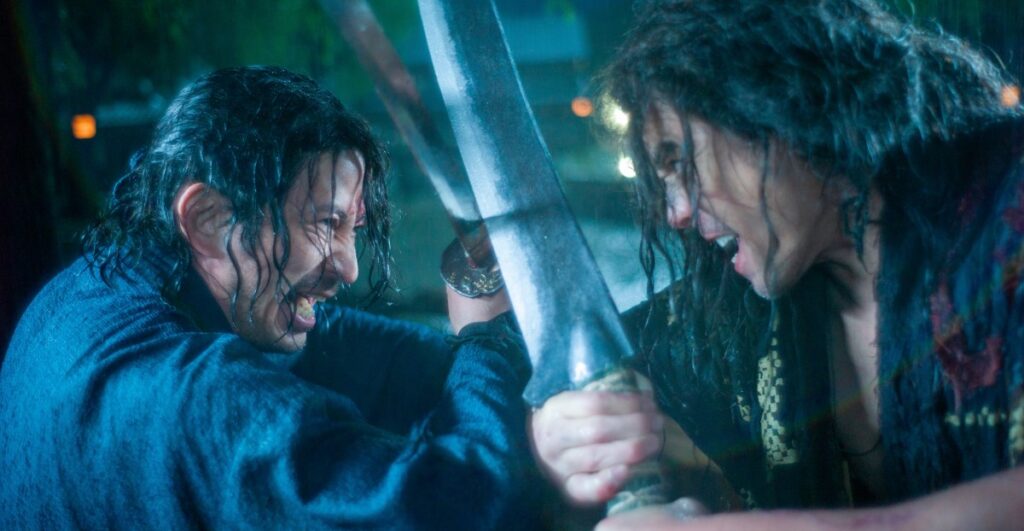
Last Samurai Standing begins with a familiar premise. Desperate samurai dispossessed by the restoration of the emperor enter into a deadly game for a life-changing cash prize — all for the entertainment of anonymous elites. Unlike its inspirations Battle Royale and Squid Game, however, Last Samurai Standing’s violence is chaotic, fast-paced, and kinetic, though it hides a careful choreography that makes the series a more electric proposition than its predecessors.
Viewers have Junichi Okada to thank for that. As well as starring in and producing Last Samurai Standing, he serves as the series’ action planner. Many will be familiar with the results of an action planner’s work — sometimes called an action director, elsewhere a “coordinator,” and even “choreographer” — though perhaps not what the role entails. In the case of Last Samurai Standing, it’s a role that touches on nearly every aspect of the production, from the story to the action itself.
“I was involved from the script stage, thinking about what kind of action we wanted and how we would present it in the context of this story,” Okada tells The Verge. “If the director [Michihito Fujii] said, ‘I want to shoot this kind of battle scene,’ I would then think through the content and concept, design the scene, and ultimately translate that into script pages.”
The close relationship between the writer and director extends to other departments, too. Though an action planner’s role starts with managing fight scenes and stunt performers, they also liaise with camera, wardrobe, makeup, and even editorial departments to ensure fight scenes cohere with the rest of the production.

Image: Netflix
It’s a role which might appear a natural progression for Okada, who is certified to teach Kali and Jeet Kune Do — a martial art conceived by Bruce Lee — and holds multiple black belts in jiujitsu. Though the roots of his progression into action planning can be traced back further, to 1995 when he became the youngest member of J-pop group V6.
“Dance experience connects directly to creating action,” he says. “[In both] rhythm and control of the body are extremely important.” Joining V6 at the age of 15, that experience has made Okada conscious of how he moves in relation to a camera during choreography, how he is seen within the structure of a shot, and, critical to action planning, how to navigate all of that safely from a young age.
That J-pop stardom also offered avenues into acting, initially in roles you might expect for a young pop star: comic heartthrobs and sitcom sons. But he was steadily able to broaden his output. A starring turn in Hirokazu Kore-eda’s Hana followed, as did voice acting in Studio Ghibli’s Tales From Earthsea and From Up on Poppy Hill. A more telling departure was a starring role in 2007’s SP, in which he played a rookie in a police bodyguard unit, for which he trained for several years under shootfighting instructor Yorinaga Nakamura.
“What I care about is whether audiences feel that ‘this man really lives here as a samurai.’”
In the years since, Okada has cemented himself as one of Japan’s most recognizable actors, hopping between action starring roles in The Fable to sweeping period epics like Sekigahara. Those two genres converge in his Last Samurai Standing role of Shujiro, a former Shogunate samurai now reduced to poverty, working through his PTSD and reckoning with his bloodthirsty past in the game. These days, it’s less of a concern that the character butts up against his past idol image, he suggests. “What I care about is whether audiences feel that ‘this man really lives here as a samurai.’”
For Okada’s work on Last Samurai Standing, as both producer and action planner, that involved lacing high-octane but believable action with the respect for history and character studies of the period dramas he loves. “Rather than being 100 percent faithful to historical accuracy,” he adds, “my goal was to focus on entertainment and story, while letting the ‘DNA’ and beauty of Japanese period drama gently float up in the background.”
A focus on what he defines as “‘dō’ — movement,” pure entertainment that “never lets the audience get bored” punctuated — with “‘ma,’” the active emptiness that connects those frenetic moments. Both can be conversations, even if one uses words and another communicates dialogue through sword blows. This is most apparent when Shujiro faces his former comrade Sakura (Yasushi Fuchikami) inside a claustrophobic bank vault that serves as a charnel house for the game’s less fortunate contestants.
“The whole battle is divided into three sequences,” Okada says. The first starts with a moment of almost perfect stillness, a deep breath, before the two launch into battle. “A fight where pride and mutual respect collide,” he says, “and where the speed of the techniques reaches a level that really surprises the audience.” It’s all captured in one, zooming take with fast, tightly choreographed action reminiscent of Donnie Yen and Wu Jing in Kill Zone.
So intense is their duel that both shatter multiple swords. The next phase sees them lash out in a more desperate and brutal manner with whatever weapons they find. Finally, having fought to a weary stalemate, the fight becomes, Okada concludes, “a kind of duel where their stubbornness and will are fully exposed” as they hack at each other with shattered blades and spear fragments.

Image: Netflix
It’s a rhythm that many fights in Last Samurai Standing follow, driven by a string of physical and emotional considerations that form the basis of an action planner’s tool kit: how and why someone fights based on who they are and their environment. Here it is two former samurai in an elegant and terrifyingly fast-paced duel. Elsewhere we see skill matched against brutality, or inexperience against expertise.
“I define a clear concept for each sequence,” Okada says, before he opens those concepts up to the broader team. From there, he might add notes, but in Last Samurai Standing, action is a collaborative affair. “We keep refining,” he says. “It’s a back-and-forth process of shaping the sequence using both the ideas the team brings and the choreography I create myself.”
There is a third factor which Okada believes is the series’ most defining. “If we get to continue the story,” he says, “I’d love to explore how much more we can lean into ‘sei’ — stillness, and bring in even more of a classical period drama feel.”
As much of a triumph of action as Last Samurai Standing is, its quietest moments are the ones that stay with you. The charged looks between Shujiro and Iroha (Kaya Kiyohara) or their shuddering fright when confronted with specters of their past. Most of all, Shujiro watching his young ward, Futaba Katsuki (Yumia Fujisaki), dance before a waterlogged torii as mist hovers. These pauses are what elevate and invigorate the breathless action above spectacle.
The pauses are also emblematic of the balance that Last Samurai Standing strikes between its period setting and pushing the boundaries of action, all to inject new excitement into the genre. “Japan is a country that values tradition and everything it has built up over time. That’s why moments where you try to update things are always difficult,” Okada says. “But right now, we’re in the middle of that transformation.”
That is an evolution that Okada hopes to support through his work, both in front of and behind the camera. If he can create avenues for new generations of talent to carry Japanese media to a broader audience and his team to achieve greater success on a global stage, “that would make me very happy,” he says. “I want to keep doing whatever I can to help make that possible.”
The first season of Last Samurai Standing is streaming on Netflix now, and a second season was just confirmed.