
This is Lowpass by Janko Roettgers, a newsletter on the ever-evolving intersection of tech and entertainment, syndicated just for The Verge subscribers once a week.
When free TV startup Telly came out of stealth in 2023, it did so with big promises: Company executives told the media at the time that Telly would ship 500,000 units of its unique TV set, which incorporates a second screen for ads and widgets, before the end of the year.
“Shipping 500,000 TVs … that’s not going to be a problem,” chief strategy officer Dallas Lawrence told StreamTV Insider in May of 2023. Two months later, Telly executives told the same outlet that the company was going to ship “millions more” in 2024.
Two years later, the company was still far from reaching that goal. In a Q3 update sent to investors in November 2025, which I was able to review, Telly revealed that it had just 35,000 TV sets in people’s homes. Telly ended the prior quarter with 28,000 TVs in the field, according to the same note.
The startup did suggest that it was about to significantly ramp up deliveries and order another 100,000 TVs from its hardware supplier, Foxconn.
Telly declined to comment on the record on specifics included in its investor update when contacted for this story.
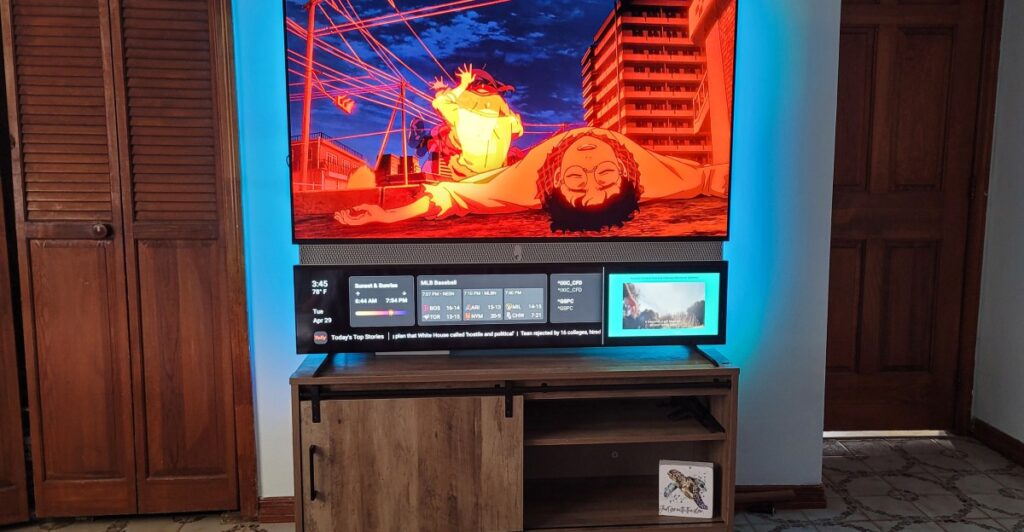
Telly’s promise is a simple one: Consumers will get a free TV in exchange for watching ads displayed on the device’s second screen. That secondary screen, positioned under the TV’s soundbar, also displays widgets with sports scores, news headlines, and even minigames. Telly TVs also come with their own voice assistant and have an integrated camera for video calls and motion games.
Interest in the device has been significant: Telly announced in June 2023 that it had gotten preorders for 250,000 TVs. However, fulfilling all those orders appears to be a lot more challenging than the company initially anticipated.
One major challenge has to do with Telly’s decision to forgo traditional retail channels: The company lets consumers preorder TVs for free online and then ships them straight to their doorsteps. Unfortunately, a lot of them have arrived damaged. On Reddit, Telly owners have posted photos of dozens of broken TVs, with some complaining that their replacement TVs arrived damaged as well.
In its Q3 investor update, Telly revealed just how widespread this problem has been: A whopping 10 percent of Telly TVs shipped via FedEx arrived broken, according to the letter. The company has since switched to a new logistics partner, and breakage has gone down significantly since, according to the letter. Posts on Reddit reveal that Telly now uses RXO, a company that is also being used by Samsung to deliver and install TVs.
Telly executives have in the past called their devices “$1,000 TVs.” Turns out giving high-priced hardware away for free, even to a small group of consumers, can be quite capital-intensive: In recent months, Telly raised two rounds of debt funding totaling $350 million, according to the investor update. (It’s unclear how much equity Telly has raised since its founding.)
There does appear to be some silver lining for Telly: The startup reached $22 million in annualized revenue in Q3 of 2025, according to the investor note. Taking into account the small number of Telly TVs in people’s homes, this suggests that each TV set could generate more than $50 in advertising revenue for the company per month. That would be significantly higher than other smart TV businesses: Roku’s average revenue per user reached $41.49 for all of 2024. (The company stopped reporting ARPU in 2025.)
In other words: Having a dedicated second screen in people’s homes that shows a constant stream of ads can be a lucrative business. Scaling that business to be more than a novelty is the hard part.
At least publicly, Telly’s leadership kept brushing off such concerns even as the company’s internal numbers remained dismal. “When investors told me [that] hardware is hard, it just didn’t sit well with me. I just called bullshit on that,” said Telly CEO Ilya Pozin during a September podcast appearance. Arguing that some of the world’s largest companies like Apple, Google, and Tesla are all doing hardware, Pozin added: “That’s what we’re doing here with Telly. I think we have an opportunity to build a trillion-dollar company.”